

PROCEDURE INFORMATION
If an individual is looking for Knee arthroscopy in JP Nagar, then Deepasri Hospital is a renowned facility known for providing quality orthopaedic assessments and treatments. Knee arthroscopy is a minimally invasive procedure that helps in the examination and treatment of knee injuries. This includes the treatment of injuries to the ACL, PCL, meniscus and cartilage.
If the torn ligament is causing ongoing instability, then ligament reconstruction may be considered. The treatment of torn knee ligaments usually depends on the severity of injury, activity levels and response to conservative treatments.
What is Knee Arthroscopy?
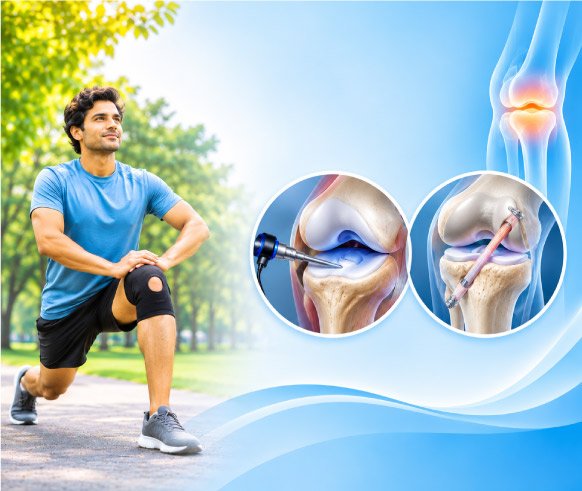
Knee arthroscopy is a minimally invasive keyhole surgery. During this procedure, a small camera (arthroscope) is inserted into the joint via a small incision. Specialised instruments are then inserted into the joint through small incisions to treat the injury to the meniscus, ligament and/or cartilage. Loose bodies can also be removed.What is Knee Ligament Reconstruction?
Ligaments attach bones together, providing stability to the knee. For severe ligament damage, a graft may be used to reconstruct the damaged ligament. This graft can be sourced from the patient’s own tissue or an appropriate donor. Unlike ligament repair, ligament reconstruction uses tissue to replace the ligament. This is commonly used for ACL injuries and may be required for some PCL and multi-ligament injuries.Common Knee Injuries Treated with Arthroscopy and Ligament Reconstruction
Depending on the diagnosis, patients may receive treatment for:- ACL Tear: Often caused by twisting or sudden change in direction.
- PCL Injury: Caused by a direct blow to the knee when it is bent.
- Meniscus Tear: Injury to the cartilage that acts as a cushion in the knee joint between the thighbone and shinbone.
- MCL Injury: Some severe and combined injuries may require surgery.
- Cartilage Damage or Loose Bodies: Can cause difficulty with smooth movement within the joint.
- Sports or Combined Ligament Injury: Can cause instability. Some may require sports injury knee surgery.
When Is Knee Arthroscopy Recommended?
Knee arthroscopy in JP Nagar, Deepasri Hospital, may be considered if patients are experiencing symptoms, such as:- Frequent knee instability
- Persistent pain and swelling following injury
- Knee locking, catching or limited movement
- Confirmed ligament or meniscal damage with persistent symptoms
- Sports injuries affecting safe movement
Types of Knee Ligament Injuries
ACL Tear
ACL helps control forward movement and rotation of the shinbone. Twisting, sudden stops and awkward landings can cause tearing. This can cause pain, swelling and instability.PCL Injury
PCL ligaments control backward movement of the shinbone. They can be injured by a direct blow to the knee when it is bent. PCL reconstruction may be considered for severe injuries or persistent instability.MCL Injury
MCL ligaments provide support to the inside of the knee. Often, bracing and rehabilitation will be used to treat MCL injuries. Some severe or combined injuries may require surgery.Multi-Ligament Injury
More than one major ligament may be injured. This will depend on the structures involved and the stability of the knee.Evaluation Before Knee Arthroscopy or Ligament Reconstruction
- The injury history, pain, swelling, instability and range of movement will be examined.
- X-rays will be used to assess the bones.
- An MRI may be performed to see any ligament, meniscal and cartilage damage.
- Preoperative blood tests and anaesthesia evaluation may also be carried out.
How Is Knee Arthroscopy Performed?
Knee arthroscopy in JP Nagar may include the following steps:- Anaesthesia will be administered.
- Small incisions will be made around the knee.
- The arthroscope will be inserted into the joint.
- The surgeon examines the internal structures of the knee.
- Surgical instruments will be inserted through additional incisions.
- Injuries will be treated as identified.
- Incisions will be closed.
How Is Ligament Reconstruction Performed?
The graft will be prepared. Small tunnels in the bone will be made at the ligament attachment points. The graft will be inserted through these tunnels and secured with fixation devices. We will check that the graft is in the correct place and movement of the knee.ACL Reconstruction Surgery
ACL reconstruction may be considered for a complete tear causing instability during pivoting activities. Associated injuries can affect the planning of the surgery. ACL reconstruction surgery in Bangalore will require rehabilitation. Return to sport usually depends on strength, balance and functional tests.Meniscus Treatment During Knee Arthroscopy
Menisci act as a cushion within the knee, distributing pressure. They may be injured alongside ligament damage. If the tear is suitable, it can be repaired with stitches and only the damaged section may be removed. Meniscus repair involves preserving healthy meniscal tissue.Benefits of Arthroscopic Surgery
Advantages of minimally invasive knee surgery:- Smaller incisions with direct visualisation of the joint.
- Treats selected ligament, meniscal and cartilage injuries.
- Less disruption to surrounding soft tissue compared with open surgery.
- Rehabilitation programme to regain movement and strength.
Recovery After Knee Arthroscopy and Ligament Reconstruction
Immediately Post Surgery
Pain management, reducing swelling and wound care. Patients may require bracing or walking aids.Physiotherapy and Rehabilitation
Physiotherapy may be provided to help with movement, strengthening of the quadriceps and hamstrings, balance, walking and gradual weight bearing.Return to Work and Sports
Recovery following arthroscopy will vary. Returning to work and sport will depend on the procedure, activity requirements, strength and functional tests.Risks & Possible Complications
- Infection
- Bleeding
- Blood clots
- Knee stiffness
- Persistent pain or swelling
- Nerve or blood vessel injury
- Recurrent instability
- Graft failure
- Reduced range of motion
- Need for further surgery in selected cases
- Anaesthesia-related complications, such as nausea and vomiting
How to Prepare for Knee Arthroscopy or Ligament Reconstruction?
- Before surgery, patients are required to get all the tests done.
- Discuss any medical conditions, medications and supplements with the treatment team.
- Follow any fasting instructions.
- Arrange transport back home.
- If required, arrange crutches or bracing.
- Commence prehabilitation only, if prescribed.
Knee Arthroscopy & Ligament Reconstruction at Deepasri Hospital
Deepasri Multispecialities Hospital, JP Nagar provides orthopaedic assessments for knee ligament and sports injuries. We can provide imaging support, arthroscopy and ligament reconstruction, if required. In addition, post-operative monitoring, physio and follow-up can be provided.Why Choose Deepasri Hospital?
- Orthopaedic assessment for ligament and sports injuries.
- Arthroscopy and ligament reconstruction, if required.
- Imaging support and modular theatre facilities.
- Post-operative monitoring, physio and rehabilitation support.
- Knee ligament surgery in JP Nagar.