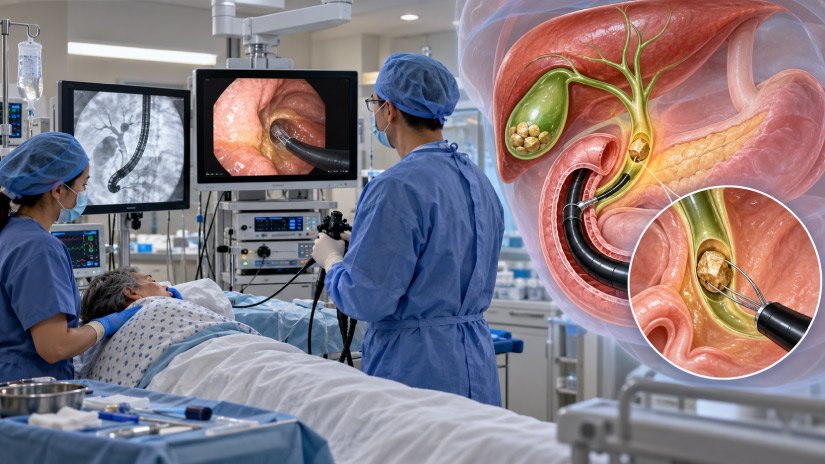
Gallstones do not always remain inside the gallbladder. A stone can move into the common bile duct, the tube carrying bile towards the small intestine. Depending on its position, it may interfere with drainage.
ERCP for bile duct stones allows a doctor to reach the duct through an endoscope and treat a blockage. It is usually considered when a stone is confirmed or sufficiently likely and an intervention is needed.
Because ERCP has procedural risks, it is not automatically the first investigation for every person with gallstones or abdominal pain.
What Are Bile Duct Stones?
The liver produces bile, which helps digest fats. The gallbladder stores bile, and ducts carry it into the intestine.
Stones within the common bile duct are called choledocholithiasis. They are different from stones confined to the gallbladder, although both may occur together.
This distinction matters because treatment must address the location of the problem. An ultrasound report showing gallbladder stones does not, by itself, establish a need for ERCP.
Ask the doctor to explain exactly where the stone has been identified.
What Symptoms May Suggest a Duct Blockage?
Possible symptoms include upper abdominal pain, yellowing of the eyes or skin, dark urine and pale stools. Fever or shivering may occur when infection develops.
These symptoms require assessment because several conditions can cause similar changes.
Blood tests and imaging help determine whether a stone is responsible.
Seek urgent medical assessment for fever with jaundice or significant abdominal pain, particularly if accompanied by confusion or marked weakness. Infection in an obstructed bile duct may require prompt drainage and other hospital treatment.
When Is ERCP for Bile Duct Stones Recommended?
ERCP may be recommended when imaging demonstrates a duct stone or when findings strongly suggest a blockage requiring treatment. Bile duct infection, called cholangitis, can make drainage more urgent.
The decision considers symptoms, blood results, imaging and general health. Gallstone-related pancreatitis does not automatically mean everyone needs immediate ERCP; evidence of cholangitis or ongoing obstruction influences that decision.
Ask what the procedure is intended to achieve and why its timing is appropriate.
Could Another Test Be Used First?
When a duct stone remains uncertain, magnetic resonance cholangiopancreatography, or MRCP, and endoscopic ultrasound may help investigate it.
MRCP uses MRI to produce images of the bile ducts.
Endoscopic ultrasound uses an ultrasound probe attached to an endoscope.
These investigations can help establish whether treatment is necessary. ERCP is generally reserved for situations where the team expects to perform an intervention, rather than obtain images alone. The sequence depends on the clinical circumstances.
What Happens During ERCP?
A flexible endoscope passes through the mouth into the stomach and first part of the small intestine. The doctor then accesses the bile duct opening using instruments passed through the endoscope.
Contrast and X-ray imaging help show the ducts. Treatment may involve:
- Making a small cut at the duct opening.
- Removing stones using a balloon or basket.
- Breaking up a difficult stone.
- Placing a stent to support drainage.
Sedation or anaesthesia is used according to the procedure and patient’s needs.
Can Every Stone Be Removed in One Procedure?
Not always. Large or difficult stones, access problems or other findings may prevent complete clearance during the initial procedure.
A temporary stent may be placed to allow drainage, with another procedure planned. Ask whether the duct was cleared and whether a stent remains.
If a stent has been inserted, obtain written instructions about removal or exchange. Feeling better does not mean the follow-up appointment can be skipped.
What Are the Risks and Preparation Steps?
Possible complications include pancreatitis, bleeding, infection, perforation and reactions to sedation.
Before ERCP for bile duct stones, tell the team about allergies, previous procedures and all medicines, especially blood thinners and diabetes treatment. Follow the fasting instructions and ask about medicine adjustments; do not stop treatment independently.
Arrange an escort if advised. Ask how long observation may last and whether your circumstances could require an
overnight stay.
Will Gallbladder Surgery Still Be Needed?
ERCP treats stones in the duct; it does not remove the gallbladder. If gallbladder stones remain, surgery may be discussed separately to address the source of further problems.
The recommendation and timing depend on recovery, other conditions and surgical suitability. Ask how duct treatment and gallbladder management fit into one plan.
Conclusion
ERCP for bile duct stones is a treatment decision based on evidence of stones, obstruction or infection. When discussing reports with
Deepasri Hospital, clarify the reason for ERCP, anticipated treatment and arrangements for stent or gallbladder follow-up.
Frequently Asked Questions (FAQs)
- Does every person with gallstones need ERCP?
No. Stones confined to the gallbladder do not automatically require ERCP. The procedure addresses selected bile duct problems.
- What symptoms after ERCP need urgent review?
Severe or worsening abdominal pain, fever, vomiting blood, black stools or breathing difficulties need immediate medical assessment. Follow the discharge instructions.
- Does ERCP remove the gallbladder?
No. Gallbladder removal is a separate operation. Whether it is appropriate should be discussed after reviewing the overall condition.